
Last updated: 10 September 2026. This policy explains what Survey Guide collects when you read surveyguide.us, what advertising and measurement tools can collect alongside it, and what you can make us do about any of it.
It is written to be read, not skimmed past. Where the honest answer is “we do not know” or “that is up to Google, not us”, it says so.
The short version
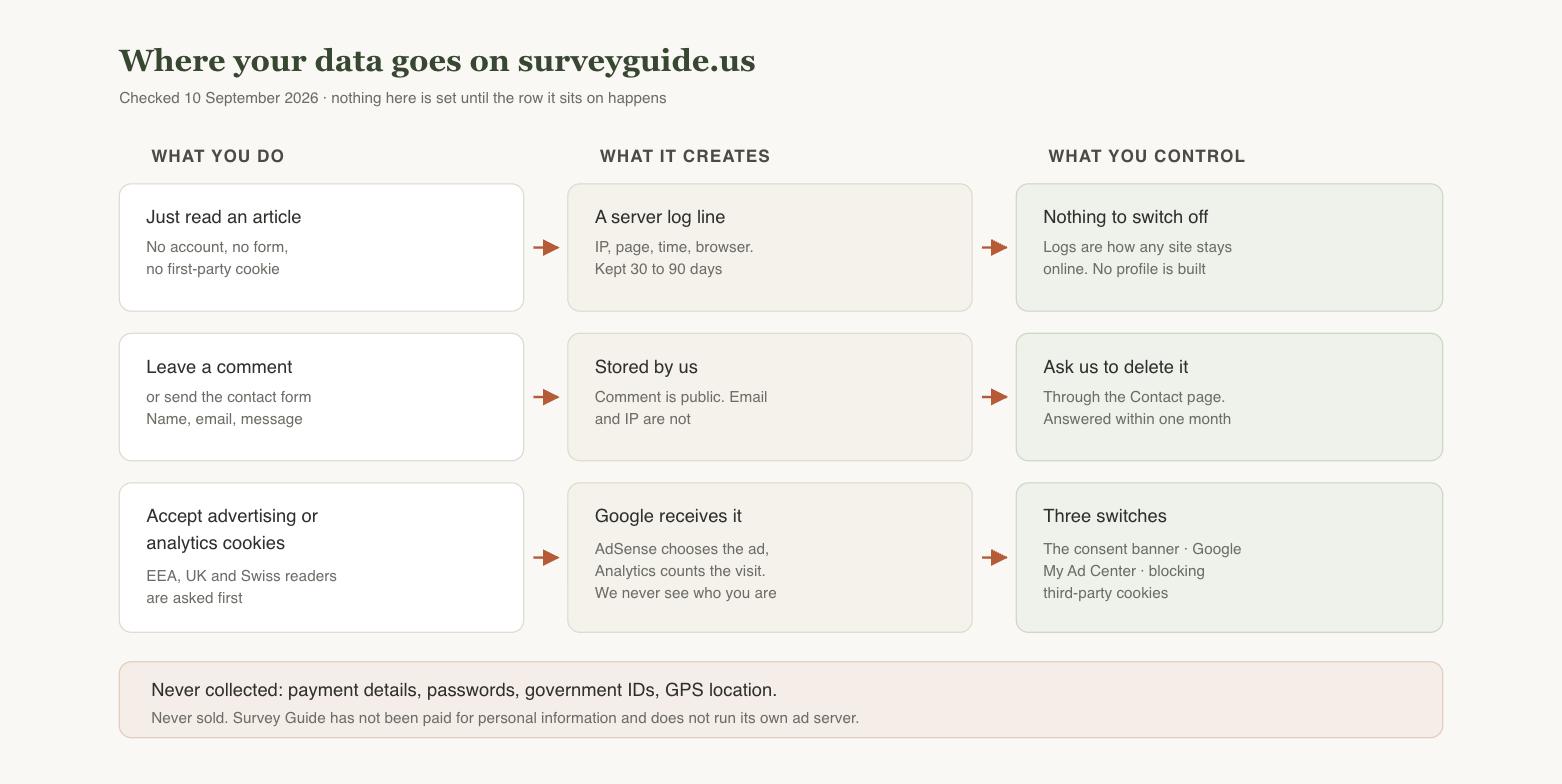
If you read nothing else, read this table. Everything below it is the detail.
| Question | Answer |
|---|---|
| Do you make me create an account? | No. There is no login, no membership and no paywall. |
| Do you ask for my name or email? | Only if you choose to leave a comment or send us a message. Reading the site asks for nothing. |
| Do you sell my personal information? | No. We do not sell it and we have never been paid for it. |
| Do you show ads? | Yes, through Google AdSense. Ad companies set their own cookies, which is the part of this page worth reading closely. |
| Do you track me across other websites? | We do not. Advertising and measurement companies can, within the limits your consent choice and your browser settings allow. |
| Can I get my data deleted? | Yes. Ask through the Survey Guide contact form and say what you want removed. |
| Who do I complain to if you get it wrong? | Your national data protection regulator, or the California Attorney General. Both are named further down. |
Who runs this website
Survey Guide (surveyguide.us) is an independent publisher of guides about customer feedback surveys, receipt surveys and the rewards attached to them, and how Survey Guide checks survey information is set out separately. We are not affiliated with, endorsed by, or operated by any brand, restaurant, retailer or survey provider written about on this site.
For anything covered in this policy, including requests to see or delete your data, use the Survey Guide contact form. That is our single intake point, and it is the address that carries privacy questions in this policy.
One limit stated plainly: we publish a contact form rather than a dedicated privacy mailbox. If you want a record of your request outside our system, keep your own copy of what you sent and the date you sent it.
What this policy covers, and what it does not
It covers surveyguide.us: the pages, the comment form, the contact form, and the advertising and measurement code that runs on those pages.
It does not cover the official survey websites we write about. When you click through to a brand’s own survey, you leave this site and that company’s privacy policy takes over. We have no visibility into what you type there, no access to your receipt or account, and no ability to delete anything on their side.
What we actually collect
What your browser sends by itself
Every website receives certain information automatically because that is how the web works. Our hosting provider records it in server logs:
- your IP address
- the page you asked for and the time you asked for it
- your browser and operating system, from the user agent string
- the page that referred you, when your browser sends one
- the response our server gave, such as whether the page loaded or errored
We use these logs to keep the site online, work out why something broke, and spot abuse such as scraping or brute-force attempts. We do not use them to build a profile of you, and we do not try to match a log line to a named person.
If you leave a comment
Comments are open on our articles. When you post one, WordPress stores what you typed, the name and email address you entered, your IP address and your browser’s user agent string. The name and comment become public. The email address and IP address do not.
Two things worth knowing before you comment. Your email address, in hashed form, may be sent to the Gravatar service to check whether you have a profile picture; Gravatar’s own privacy policy applies to that check. And if you tick the box that saves your details, WordPress stores three cookies in your browser, named comment_author, comment_author_email and comment_author_url, which last about a year and exist only so the form is pre-filled next time.
You can leave a comment without ticking that box. You can also ask us to delete a comment and the data attached to it.
If you use the contact form
The form on our contact page runs on Contact Form 7 and collects your name, your email address, a subject line and your message. It emails that to us. We keep the email so we can reply and so we can check later whether a correction was actually made.
Send us the page URL and the official source that contradicts it. Do not send us a full receipt image, a survey code, a card number, an account password or anything similar. We do not need it, and we would rather it never reached our inbox.
What we never collect
- Payment details. Nothing on this site is for sale and there is no checkout.
- Passwords or account credentials for any brand, survey provider or rewards program.
- Government identifiers such as a Social Security number.
- Precise location. We do not ask your browser for GPS coordinates.
Cookies and the things that behave like cookies
A cookie is a small file a website asks your browser to keep. Some are set by us, some by companies whose code runs on the page. Local storage and web beacons do a similar job and are covered by the same rules here.
Cookies this site sets itself
| Cookie | Set when | Roughly how long | What it does |
|---|---|---|---|
| comment_author, comment_author_email, comment_author_url | You leave a comment and tick the save-my-details box | About one year | Pre-fills the comment form on your next visit |
| WordPress session and login cookies | Only for site administrators signing in | Session, or up to two weeks | Keeps the person editing the site signed in. Readers never receive these |
That is the whole list of first-party cookies. If you never comment and never sign in, this site sets none of its own.
Cookies advertising and measurement can set
These are not ours. They are placed by Google and, in the case of advertising, potentially by other companies buying space through Google’s systems. They are described in the two sections that follow, because they are the part of this page that actually matters.
Turning cookies off in your browser
Every major browser lets you block or delete cookies, and every major browser buries the setting somewhere different. Look for Privacy and security in Chrome, Edge or Brave, or Privacy and Security in Firefox and Safari. Blocking all cookies will not break the reading experience here, because nothing on this site needs a cookie to display an article.
Advertising: how Google AdSense works on this site
Survey Guide carries display advertising through Google AdSense. Advertising pays for hosting and for the time it takes to re-check pages when a survey changes. It does not decide what we write, and no advertiser sees an article before it is published.
The disclosures Google requires us to make
Google asks every AdSense publisher to state the following, so here it is in the wording Google asks for:
- Third party vendors, including Google, use cookies to serve ads based on a user’s prior visits to this website or other websites.
- Google’s use of advertising cookies enables it and its partners to serve ads to you based on your visit to this site and/or other sites on the Internet.
- You may opt out of personalised advertising by visiting Google Ad Settings.
- Alternatively, you can opt out of a third-party vendor’s use of cookies for personalised advertising at aboutads.info.
What that means in ordinary language
Google’s ad systems can use a cookie in your browser to remember, in a rough sense, what kinds of pages you have looked at, then use that to choose which advert to show you here. The advert you see may therefore be different from the one someone else sees on this exact page.
We do not receive that profile. We do not know who you are, we do not see your Google account, and we cannot look up what any individual reader was shown. What reaches us is a count of impressions and earnings, aggregated across everybody.
Turning personalised ads off
Three routes, and they do different things:
- Google’s My Ad Center turns off ad personalisation across Google’s own products and partner sites.
- The Digital Advertising Alliance page at aboutads.info/choices and the Network Advertising Initiative page at optout.networkadvertising.org cover many vendors at once. European readers have the equivalent at youronlinechoices.eu.
- Blocking third-party cookies in your browser stops most of it at the source, without depending on any company honouring a preference.
Turning personalisation off does not remove the adverts. It makes them less relevant, which is exactly the trade you are being offered.
Other advertising companies
Google’s ad exchange lets other networks and vendors bid for space here. We do not have a fixed, published list of them, because the set changes automatically and no publisher receives a complete roster. Google’s own explanation of how this works, and the vendors involved, is in How Google uses information from sites or apps that use our services. If you want the full technical picture, that page is the primary source, not this one.
We do not run our own ad server, we do not sell space directly, and we do not place tracking pixels for advertisers on our pages.
Measurement: analytics and Search Console
Two Google products are used, or planned, to understand how the site performs. Neither is used to identify individuals.
| Tool | What it does here | Cookies? |
|---|---|---|
| Google Analytics 4 | Counts visits, tells us which guides get read and which get abandoned, and roughly where traffic comes from. IP addresses are truncated by Google before storage under GA4’s default behaviour | Yes, first-party cookies beginning _ga |
| Google Search Console | Shows which search queries reach the site and which pages have crawl or index errors. It reads Google’s own search data, not your browser | No cookies set on visitors |
Google’s handling of this data is governed by Google’s privacy policy. If you would rather not be counted at all, Google publishes a browser add-on that blocks Analytics entirely: the Google Analytics Opt-out Browser Add-on.
Why we are allowed to use your data at all
Under the UK and EU General Data Protection Regulation, every use of personal data needs a lawful basis. Ours are these:
| What we do | Lawful basis | Why |
|---|---|---|
| Keep server logs | Legitimate interests | Running a website securely is not possible without them, and the impact on you is minimal |
| Publish and moderate comments | Consent | You chose to type it and press submit. You can withdraw it by asking us to delete the comment |
| Reply to a contact form message | Consent, and legitimate interests | We cannot answer you without keeping what you sent |
| Set advertising or analytics cookies for visitors in the EEA, the UK or Switzerland | Consent | These are not necessary to display an article, so they wait for your answer to the consent banner |
| Keep records of corrections we made | Legitimate interests | So a claim we fixed something can be checked later |
Your rights in the EEA, the UK and Switzerland
If you are in the European Economic Area, the United Kingdom or Switzerland, the GDPR and its UK and Swiss equivalents give you the rights below. They apply to you whether or not you have ever commented here.
The rights themselves
- Access. Ask what personal data we hold about you and get a copy.
- Rectification. Have something inaccurate corrected.
- Erasure. Have it deleted, where we have no overriding reason to keep it.
- Restriction. Tell us to stop using it while a dispute is sorted out.
- Objection. Object to any use we base on legitimate interests, including for direct marketing.
- Portability. Receive what you gave us in a machine-readable file.
- Withdraw consent. At any time, without affecting anything done before you withdrew it.
How to use them
Send the request through the our contact form. Tell us which right you are exercising and give us enough to find you, which for a comment usually means the article and the name you posted under. We answer within one month, as the GDPR requires. If a request is genuinely complicated we may take longer, and we will tell you why before the month is out rather than after.
We will not charge you, and we will not ask for a copy of your passport to prove who you are. If we cannot match a request to any data, we will say that instead of pretending to have deleted something.
Consent, and the banner
Advertising and analytics cookies are not necessary to read an article, so for visitors in the EEA, the UK and Switzerland they are not set until a consent banner has asked. Since 16 January 2024 Google has required publishers serving personalised ads to those visitors to use a Google-certified consent management platform integrated with the IAB Transparency and Consent Framework, and that is the mechanism the banner runs on. Where consent is declined or not given, ads still appear but are non-personalised or limited.
You can change your answer at any time through the banner’s settings link, which stays reachable after the first choice.
Where your data goes
Our hosting is provided by a third-party web host, and Google’s advertising and measurement infrastructure is global. That means personal data covered by this policy may be processed outside the EEA and the UK, including in the United States. Google relies on the EU-US Data Privacy Framework and on Standard Contractual Clauses for those transfers, and describes the arrangement in its own privacy documentation.
Complaining about us
You can complain to a supervisory authority without asking us first. In the UK that is the Information Commissioner’s Office. In the EU it is the data protection authority of the country you live in. In Switzerland it is the Federal Data Protection and Information Commissioner. We would rather you told us first so we can fix it, but that is your choice and not a condition.
One honest note for readers in the EEA. Survey Guide is a small independent publisher operating outside the EU, and we have not appointed an Article 27 representative inside the Union. If that changes, this section will name them.
Your rights in California
California has the strongest consumer privacy law in the United States, in the form of the CCPA as amended by the CPRA. The rights below are written for California residents.
Whether the law technically applies to us
Probably not, and we would rather say so than imply an obligation we do not have. The CCPA applies to businesses above certain thresholds: annual gross revenue over 25 million dollars, buying or selling the personal information of 100,000 or more California consumers or households, or deriving 50 per cent or more of revenue from selling or sharing personal information. Survey Guide meets none of those.
We honour the rights anyway. A privacy right that only exists when a lawyer forces the issue is not much of a right.
Categories we collect
| Category under the CCPA | Do we collect it? | Where from |
|---|---|---|
| Identifiers, such as IP address, name, email address | Yes | Server logs, comments, contact form |
| Internet or network activity, such as pages viewed and referring page | Yes | Server logs, analytics, advertising cookies |
| Commercial information, such as purchase history | No | |
| Geolocation data | Coarse only | An approximate region inferred from IP address by advertising and analytics services. Never GPS |
| Biometric information | No | |
| Sensitive personal information as defined by the CPRA | No | We do not collect it and therefore have nothing to limit the use of |
Your rights
- Right to know what personal information we have collected, where it came from, why, and who we disclosed it to.
- Right to delete personal information we collected from you.
- Right to correct inaccurate personal information.
- Right to opt out of sale or sharing of personal information.
- Right to limit the use of sensitive personal information, which is moot here because we collect none.
- Right to non-discrimination. Nothing on this site is withheld, delayed or degraded because you exercised a privacy right. There is nothing to withhold; every article is free to everyone.
Make any of these requests through the the same contact form. You can use an authorised agent, in which case we will ask for written proof that you authorised them.
The honest answer on “sale” and “sharing”
We do not sell personal information for money, and we never have. But California defines “sharing” broadly enough that letting an advertising cookie pass information to Google for cross-context behaviouraladvertising can count as sharing even when no money changes hands, and we would rather tell you that than hide behind the word “sell”.
So: if you are in California and you want that to stop, do not rely on us to guess. Use the opt-out routes in the advertising section above, or send us a request. Turning off ad personalisation at My Ad Center and blocking third-party cookies are the two steps that actually change what happens in your browser.
Global Privacy Control
If your browser or an extension sends the Global Privacy Control signal, we treat it as a valid opt-out of sale and sharing for that browser, as California requires. You do not have to send us anything separately. The signal applies per browser and per device, so setting it on your laptop does nothing for your phone.
The older Do Not Track header is a different thing and is worth being straight about. No industry standard was ever agreed for how sites should respond to it, most sites ignore it, and browsers have largely retired it. We do not act on Do Not Track. We do act on Global Privacy Control.
Shine the Light
California’s older Shine the Light law lets residents ask, once a year, about personal information disclosed to third parties for their direct marketing purposes. We do not disclose personal information for that purpose, so there is nothing to report, but you are entitled to ask and we will confirm it in writing.
Other United States privacy laws
Virginia, Colorado, Connecticut, Utah, Texas, Oregon and a growing list of other states have passed consumer privacy laws with rights that broadly mirror the Californian ones: know, delete, correct, and opt out of targeted advertising. If you live in one of those states, send the request through the the Survey Guide contact page and we will handle it the same way. We do not maintain a separate procedure per state, because the answer would be identical in each.
How long we keep things
| What | How long | Why |
|---|---|---|
| Server logs | Typically 30 to 90 days, depending on our host’s retention settings | Long enough to investigate an outage or an attack, not long enough to be a profile |
| Published comments and the data attached to them | Indefinitely, or until you ask us to remove them | A comment thread that loses half its replies stops making sense |
| Contact form emails | Up to 24 months | So we can check later whether a correction was actually applied |
| Analytics data | Governed by Google’s retention setting, commonly 14 months | Set inside Google Analytics, not on our server |
| Advertising data | Held by Google and its partners under their own policies | We do not hold it and cannot delete it for you |
The last row is the important one. If you want advertising data deleted, the request goes to Google, not to us. We can stop the cookie loading on our pages for you; we cannot reach into Google’s systems.
If this website changes hands or shuts down
If Survey Guide is ever sold, merged or transferred, the comment archive and contact records would move with it, because they are part of the site. Any buyer would be bound by this policy until they publish their own, and a change of that size would be announced at the top of this page rather than slipped in quietly.
If the site shuts down instead, comment data and contact records are deleted rather than sold on. We would rather delete an archive than turn it into an asset.
Children
This site is written for adults holding a receipt, and it is not directed at children under 13. We do not knowingly collect personal information from them. If you believe a child has left a comment containing personal information, tell us through the the contact form and we will remove it without asking you to prove anything.
Advertising on this site is configured as non-personalised for anyone Google identifies as a child, in line with Google’s own policies.
Security, and what we cannot promise
The site runs over HTTPS, so what passes between your browser and our server is encrypted in transit. Administrator access is limited and the software is kept updated.
What we will not tell you is that your data is perfectly safe, because no website can honestly say that. If a breach ever affects personal data held here, we will notify the people affected and the relevant regulator within the timeframes the law sets, and we will say what happened rather than issue a paragraph of reassurance.
Links to other websites
Our guides link out constantly, mostly to official brand pages, survey providers and primary sources. Those links are the point of the site. Once you follow one, this policy stops applying and theirs begins.
We check that a link works and points where we say it points. We do not audit the privacy practices of the companies at the other end, and we would be lying if we said otherwise.
Changes to this policy
When something material changes, such as a new advertising partner or a new measurement tool, we update this page and change the date at the top. Small wording fixes happen without an announcement. Material changes get a note in this section so you can see what moved.
We do not backdate. If the date at the top says 10 September 2026, that is the day this text was last edited.
Is Survey Guide safe to use?
Yes, in the narrow sense that matters: reading this site costs you nothing, asks you for nothing, and installs nothing. There is no login, no download, no paywall and no popup asking for an email address before you can see the article.
The risk in this corner of the web is not usually the guide, it is the copycat. Pages that rank for survey terms sometimes ask for a card number to “release” a prize, or collect a full receipt image, or push a browser extension. Survey Guide asks for none of those, and neither does any legitimate restaurant survey.
One line worth keeping: we are an independent guide, not the survey operator. We cannot see your entry, issue a reward or access your account with any brand, which also means we never need your credentials for anything.
Questions people actually ask about privacy here
Do I have to accept cookies to read an article?
No. Nothing on this site needs a cookie to display an article. Decline everything on the consent banner, or block cookies at browser level, and every guide still loads in full. You lose nothing but ad relevance.
Do you know who I am when I read a page?
No. Without an account there is nothing to attach a name to. What exists is a log line with your IP address and a page URL, and an aggregated visit count in analytics. We cannot look up an individual reader and we have never tried.
Why am I seeing ads about something I searched for on another website?
Because that is what personalised advertising does, and it is happening in your browser rather than on our server. Google chose that ad using its own record of your browsing, not anything Survey Guide told it. The three switches in the advertising section above are what stops it.
Can I use an ad blocker or browse without JavaScript?
Yes, and nothing here will nag you about it. Articles are plain text, tables and images, so they render without scripts. We do not detect ad blockers and we do not gate content behind turning one off.
Is the email address I use for a comment visible to anyone?
No. WordPress stores it but never displays it, and it is not published, sold or added to a mailing list. The only thing it does is check Gravatar for a profile picture, in hashed form.
What should I include when I ask you to delete something?
The article URL, the name you commented under, and roughly when you posted. That is normally enough to find it. Do not send a copy of your ID; we will not ask for one and we do not want one on file.
What is actually running on this site today
Most privacy policies describe an aspirational website. This one describes the real one, checked on the date at the top:
| Component | Status on 10 September 2026 |
|---|---|
| Google AdSense | Being introduced. Until it is live, no advertising cookies are set by this site |
| Google Analytics 4 | Being introduced |
| Google Search Console | Search-side only. Sets no cookies on visitors |
| Consent banner for EEA, UK and Switzerland | Being introduced alongside advertising, and required before personalised ads can run for those visitors |
| Comments | Live, on articles |
| Contact form | Live, on the Contact page |
| Newsletter or mailing list | None. We do not collect email addresses for marketing |
| Selling personal information | Never |
This block gets updated when any of it changes. If you find it out of date, that is a correction worth reporting through the that same form, the same as a wrong survey rule.
Survey Guide is an independent informational website. This policy explains our own practices; it is not legal advice, and it does not describe what happens on the official survey websites we link to. Brand names and trademarks belong to their owners.